.avif)
Client
Remedy Place
Project Type
Website, Art Direction, UX
Industry
Wellness
.avif)
Remedy Place is the world’s first social wellness club. We worked with their founder to establish a digital presence for the brand that lived up to the in-person experience before they expanded to new locations.
We partnered with Traackr and brand strategy firm Unknowns to lead a full brand refresh and new website that repositions the company around its founding conviction: that data, paired with imagination, is how the next generation of brands will be built.
.avif)
Remedy Place doesn't fit cleanly into any existing category. It isn't a gym, isn't a spa, isn't a medical clinic — and Dr. Leary has been deliberate from the beginning that it should feel like none of them. The club is a social environment for self-care: ice baths, sound baths, hyperbaric chambers, IV therapy, all designed to be experienced together. The interiors are warm. The lighting is low. There is, intentionally, no blue anywhere on the property.
When Remedy Place came to us, they were building toward their second location in New York, and the website needed to evolve from a single-location showcase into the digital front door of a growing club. The architecture had to anticipate locations that didn't exist yet. The experience had to serve three completely different guests at once: someone curious enough to book a tour, a member booking their next treatment, and a prospective member ready to commit.
.avif)
.avif)
Designed from the inside out
Before we drew a single screen, the team drove to West Hollywood to experience the club the way a member would. We took a sound bath. We sat in the ice bath. We did the hyperbaric chamber. What we were really there for was the sensory layer — the lighting, the materials, the music, the temperature of the air. Remedy Place's most defining quality is how it feels when you walk in, and any website that didn't carry that feeling forward would be missing the point.
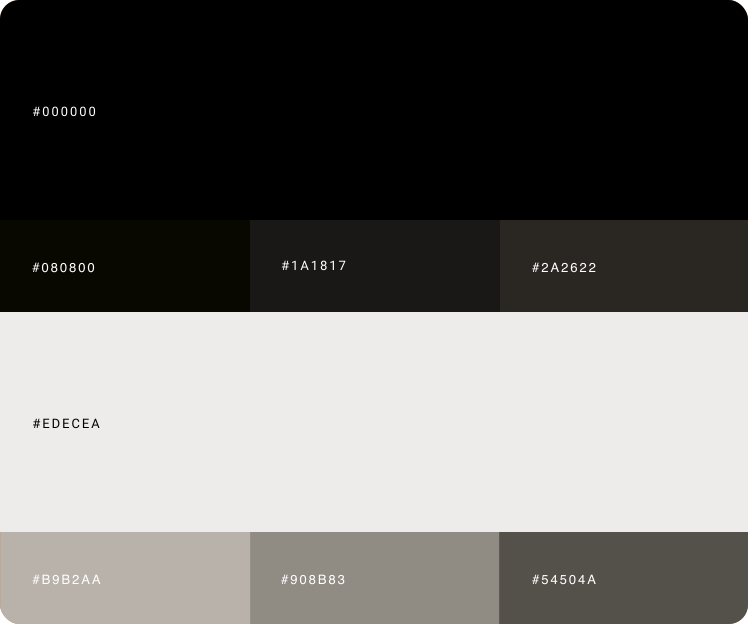
What came out of that visit shaped every design decision that followed. The site's color, typography, and art direction were all calibrated to echo the room — warm where the room is warm, quiet where the room is quiet. The intent was to give members a hint of the physical experience the moment they land, so the digital and the physical reinforce each other instead of feeling like two separate brands.
Anything but a medical office
One of the clearest principles from Dr. Leary, and one we held throughout: Remedy Place should never feel clinical. No blue, anywhere. No medical iconography, no sterile whites, no language that belongs on a hospital intake form. The brand operates in a category adjacent to medicine, but it's hospitality first — and the website had to read that way at a glance.
.avif)
.avif)
Three guests, one experience
The site had to serve three very different journeys without forcing any of them to wade through the others. First-time guests needed a way to understand what Remedy Place actually is and book a tour. Existing members needed to book treatments quickly and without friction. Prospective members needed enough to commit to a membership without ever feeling sold to.
We designed the architecture to surface the right path early, with each journey getting its own clear thread through the site. The navigation, the content modules, and the booking flows were all built to let any of those three guests get where they're going in the fewest possible steps — without flattening the brand into a transactional experience.
Built for multi-location from day one
The site was architected for a club that was still becoming a network. Every page, every booking surface, every piece of content was designed to scale across locations without losing the sense that each property is its own destination. New York launched into a system that was already waiting for it; the locations that followed have done the same.
.avif)
The technical foundation
The site runs on Sanity, the headless CMS that gives the Remedy Place team granular control over content across every location and every modality, and integrates with Zenoti for the booking infrastructure that powers membership and treatment reservations. The architecture is invisible to the guest — which, in a category obsessed with showing off its technology, is the point.
.avif)
.avif)
.avif)